

A-level Media Studies - Handbook

Updated: Sep 4

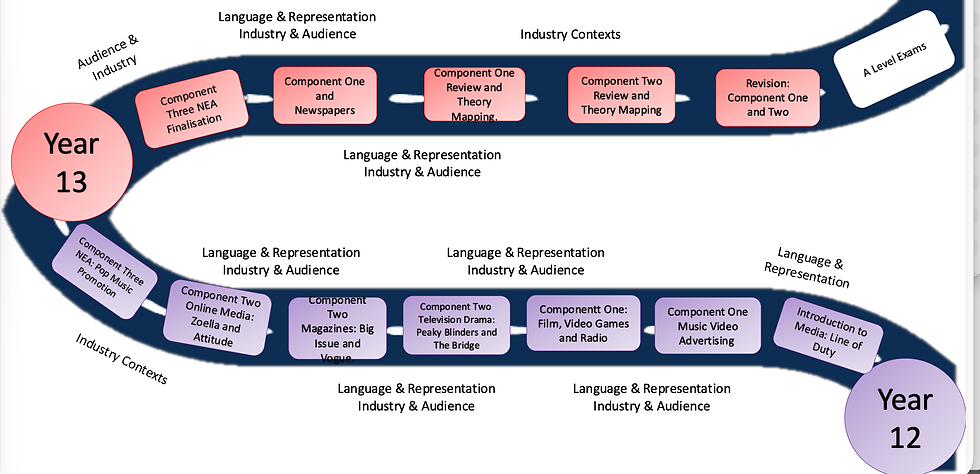
Our spiral curriculum is designed to ensure that students encounter every key area of the course twice, with each revisit building on previous learning. The first pass introduces the core knowledge, terminology, theories and case studies, allowing students to develop a secure foundation and begin making connections between concepts. The second pass deliberately revisits the same material at greater depth, strengthening recall, refining analytical skills and addressing misconceptions. Rather than learning something once and moving on, students repeatedly retrieve, apply and extendtheir knowledge. This approach supports long-term retention, increases confidence and ensures that understanding becomes progressively more sophisticated as students move towards their final examinations.
Component One
Year 12 - Introduction to Media Studies - Autumn 1, 2026
Students begin by developing the core skills needed to study media critically. They explore Media Language, Representation, Industry and Audience, learning how media products communicate meanings and how audiences interpret them. Roland Barthes’ semiotic theory provides a foundation for understanding signs, symbols, connotations and denotations. Through the study of Line of Duty, students investigate how television drama constructs characters, narratives and meanings through camerawork, editing, sound, mise-en-scène and genre conventions. This opening unit establishes the analytical vocabulary students will use throughout the GCSE, while encouraging them to question how media products reflect, reinforce and sometimes challenge ideas about society, identity, power and culture.
Introduction to Media Studies: Media Language, Representation, Industry, and Audience – establishing a theoretical framework for analysis. Roland Barthes Semiotics, Line of Duty.
Year 12 - Music Video - Autumn 1, 2026
Music videos combine music, moving image, performance, narrative and visual style to create distinctive media experiences. Students trace the history of the music video, exploring changing technologies, conventions and audiences, from early promotional films to MTV and the emergence of New Pop. They analyse contrasting case studies including Vance Joy’s Riptide and Beyoncé’s Formation, considering representation, identity, gender, race and ideology. Students apply theories including Bell Hooks’ ideas about representation and Laura Mulvey’s male gaze, while examining how artists construct their public identities. The unit develops close textual analysis and prepares students to recognise how music videos communicate meanings through image, sound, editing and performance.
Exploration topics broaden students’ understanding of media by connecting theory and media products to wider historical, cultural and social contexts. Students investigate Black Lives Matter and the legacy of the slave trade, considering how representation and media narratives influence public understanding. They explore Western genre conventions, the distinctive visual style of Wes Anderson, and the concept of intertextuality. Students also examine Eisenstein’s theory of montage and the revolutionary filmmaking approaches associated with French New Wave cinema. These explorations encourage students to make connections between different media forms, develop independent interpretations and understand how media products are shaped by historical circumstances, artistic movements, political debates and changing technologies
Year 12 - Advertising - Autumn 2, 2026
Advertising introduces students to the ways media industries persuade audiences and construct desire. Students explore the history and conventions of advertising, examining how products, brands and audiences are represented through visual language, narrative, celebrity, humour and ideology. Case studies including Kiss of the Vampire, Tide and Super.Human provide contrasting examples across different historical periods and media contexts. Students investigate postmodernism, including ideas associated with Jean Baudrillard, and consider how advertising can recycle, parody and transform existing cultural meanings. Van Zoonen and Gauntlett help students explore gender representation and identity. The unit develops students’ ability to analyse advertising as both creative communication and commercial persuasion.
Students extend their advertising knowledge by exploring the social and historical contexts behind media campaigns. Arrival provides an opportunity to consider science fiction, representation and contemporary culture, while the Paralympics explores changing representations of disability, achievement and identity. Students investigate Hammer Horror and the visual conventions associated with horror, alongside the contrasting cultural contexts of the 1950s and 1960s. These topics demonstrate how advertising and popular media respond to changing social attitudes, technologies and cultural expectations. Students learn to place media products within their historical contexts and consider how representations can challenge stereotypes, reinforce dominant ideologies or contribute to changing perceptions of individuals and groups.
Advertising: History of Advertising, Postmodernism, Kiss of the Vampire, Tide, Super.Human, Van Zoonen, Gauntlett.
Explorations: Arrival, Paralympics, Hammer Horror, The Fifties and Sixties,
Year 12 - Film Marketing - Autumn 2, 2026
Film marketing introduces students to the relationship between film, audiences, institutions and commercial culture. Through Black American Cinema, students explore the representation of Black identities and the historical development of opportunities within the film industry. Case studies including Marvel’s Cinematic Universe and Black Panther allow students to examine blockbuster marketing, genre, representation, global audiences and corporate power. Social realism, I, Daniel Blake and the work of Ken Loach provide a contrasting perspective, highlighting how films can address contemporary social and political issues. Students apply Hesmondhalgh and Curran and Seaton to examine media industries, ownership, regulation and the relationship between commercial success, creativity and representation.
Students investigate the wider cultural and political contexts surrounding film representation. Afrofuturism introduces alternative visions of Black identity, technology and the future, while the Harlem Renaissance and Black Panthersprovide historical context for understanding Black cultural and political expression. Students explore the significance of #OscarsSoWhite and debates surrounding diversity within the film industry. Universal Credit and austerity provide a context for understanding social realism and representations of poverty, inequality and contemporary Britain. The role of the BFI introduces students to cultural institutions and their influence on film production, preservation, funding and access. These explorations encourage students to connect media texts with wider social debates.
Year 12 - Video Games — Spring 1, 2027
Video games are explored as an interactive and increasingly influential media form. Students study the Assassin’s Creed franchise, considering how games construct historical worlds, characters, narratives and player experiences. They explore the relationship between gameplay, representation, technology and audience participation. The work of Henry Jenkinsintroduces ideas surrounding participatory culture and convergence, while Clay Shirky encourages students to consider changing patterns of participation and digital media consumption. Bandura provides a framework for considering media effects and debates surrounding behaviour and representation. Students also investigate the history of video games, developing an understanding of how technological developments have transformed production, distribution, gameplay and relationships between media producers and audiences.
Video Games: Assassins Creed, Henry Jenkins, Clay Shirky, Bandura.
Explorations: History of Video Games,
Year 12 - Radio — Spring 1, 2027
Students explore radio as a powerful form of audio storytelling and public communication. Beginning with the history of radio, they investigate how broadcasting has developed alongside technological, social and cultural change. Woman’s Hour provides a detailed case study through which students analyse representation, audience, institutions, genre and public service broadcasting. Judith Butler’s ideas about gender and identity support discussion of how radio programmes construct and challenge representations. Students also explore the concept of Public Service Broadcastingand consider how broadcasters serve different audiences and reflect national identities. The unit encourages students to recognise the distinctive strengths of radio, particularly its ability to create meaning through voice, sound, music, interview and language.
This exploration unit examines radio within its wider cultural and historical context. Students investigate Public Service Broadcasting and consider its role in informing, educating and entertaining audiences. The concept of Middle Englandprovides a useful way of exploring ideas about British identity, class, culture and belonging, particularly through representations of everyday life. Students consider how media institutions construct particular versions of national identity and how audiences may accept, negotiate or challenge these representations. These contextual explorations strengthen students’ ability to move beyond textual analysis and consider why a media product was created in a particular form, for a particular audience, at a particular historical moment.
Radio: History of Radio, Woman's Hour, Judith Butler,
Explorations: Public Service Broadcasting, Middle England,
Component Two
Year 12 - Television Drama — Spring 2, 2027
Students explore television drama through the development of genre, narrative and representation. The Bridge and Peaky Blinders provide contrasting case studies through which students examine how television constructs characters, settings, identities and narratives. Students apply Steve Neale’s genre theory, exploring the relationship between repetition and difference, while Claude Lévi-Strauss introduces binary oppositions as a way of understanding narrative conflict. Todorov’s narrative theory provides a framework for analysing equilibrium, disruption and resolution. Students also explore the conventions of television drama and how production choices communicate meaning. The unit develops sophisticated textual analysis while encouraging students to consider historical, cultural and industrial contexts.
Students investigate the cultural contexts surrounding television drama through Nordic Noir, Scandinavian culture and Film Noir. These areas allow students to explore how genre conventions travel between countries and develop in different cultural environments. They examine the influence of Film Noir on contemporary crime drama and consider how lighting, setting, characterisation and narrative create distinctive moods and meanings. Historical context is developed through exploration of World War One and period drama, examining how television reconstructs the past for contemporary audiences. Students learn to recognise the relationship between genre, history, culture and representation, while developing the ability to compare media products across different periods and national contexts.
Television Drama: History of Television Drama, The Bridge, Peaky Blinders, Steve Neale, Levi Strauss, Todorov,
Explorations: Nordic Noir, Scandinavian Culture, Film Noir, World War One, Period Drama
Year 12 - Magazines - Spring 2, 2027
Students explore magazines as highly constructed forms of print and digital media. They investigate the history and conventions of magazines, examining how cover design, typography, photography, colour, layout and language target specific audiences. Vogue and The Big Issue provide contrasting case studies, allowing students to explore differences in purpose, audience, representation and institutional identity. Uses and Gratifications theory encourages students to consider why audiences consume magazines and what needs media products can fulfil. Students develop close analytical skills while considering how magazines construct ideas about identity, lifestyle, class, gender and culture. The unit also highlights the relationship between creative design, commercial pressures and audience expectations.
Students investigate the cultural contexts surrounding magazine production and design. The 1960s provide an important historical context for exploring changing youth culture, fashion, music and media consumption. Students examine the importance of fonts and lettering, considering how typography communicates identity, tone and meaning. Grayson Perry provides an opportunity to explore contemporary art, identity and representation, while cultural institutionsintroduce questions about who decides what is culturally valuable and how audiences engage with culture. These explorations help students understand that magazines are more than collections of articles and images: they are carefully designed cultural products shaped by historical change, artistic conventions, commercial interests, institutional values and audience expectations.
Magazines: History of Magazine, Magazine Conventions, Vogue, Big Issue, Uses and Gratifications
Explorations: The 1960s, , Fonts and Lettering, Grayson Perry, Cultural Institutions.
Year 12 - Online Media - Summer 1, 2027
Students explore the transformation of media through the internet, social media and digital participation. They investigate the rise of celebrity bloggers and the development of platforms such as YouTube, considering how digital technologies have changed relationships between producers and audiences. Zoella provides a case study of influencer culture, celebrity and participatory media, while Attitude allows students to explore online magazine publishing and LGBTQ+ representation. Students examine how audiences can simultaneously consume, produce, share and respond to media content. The unit considers the opportunities and challenges created by digital media, including changing ideas about celebrity, identity, community, representation, commercialisation and the power of audiences.
Students place online media within wider social and historical contexts. The AIDS crisis of the 1980s provides an important context for examining representation, stigma, sexuality and changing public attitudes. Students explore LGBTQ+ history, considering how media representations have developed from marginalisation and stereotyping towards greater visibility and diversity, while recognising continuing debates around representation. The question “What is trending?” introduces the rapidly changing nature of online culture and audience behaviour. Students consider algorithms, virality, participation and digital communities, developing an understanding of how online media can shape public conversations while also reflecting existing social, cultural and political attitudes.
Online Media: The Rise of Celebrity Bloggers, Internet and YouTube, Zoella and Attitude
Explorations: AIDS Crisis in 1980s, LGBTQ+ History, What is Trending?
Year 12 - Music Promotion NEA - Summer 2, 2027.
Students put their knowledge of media language, representation, industry and audience into practice through a complete music promotion campaign. Working from an Eduqas brief, students create a music video for a fictional artist, combining performance and narrative while using genre conventions, camerawork, editing, mise-en-scène and sound to target a defined audience. They also design an artist website, developing a consistent visual identity across their promotional materials through typography, colour, imagery and branding. A 45-second interview provides an additional opportunity to construct the artist’s identity and public persona. The project develops research, planning and production skills, culminating in a cohesive, professional and creatively controlled promotional campaign.
Year 13 - Music Promotion NEA - Autumn 1, 2026.
Students put their knowledge of media language, representation, industry and audience into practice through a complete music promotion campaign. Working from an Eduqas brief, students create a music video for a fictional artist, combining performance and narrative while using genre conventions, camerawork, editing, mise-en-scène and sound to target a defined audience. They also design an artist website, developing a consistent visual identity across their promotional materials through typography, colour, imagery and branding. A 45-second interview provides an additional opportunity to construct the artist’s identity and public persona. The project develops research, planning and production skills, culminating in a cohesive, professional and creatively controlled promotional campaign.
Overview of Brief, Camerawork and Lighting for Green Screen,
Use of Props, Visual Codes of Genre, Storyboard and Production Schedule Guide
Website Review, 45 Second Reel, Finding a Track Without a Video
Using Green Screen For Backgrounds, Rock n Roll Aesthetics UK Tribes Audience
World Building, Web Design, Statement of Aims. XL and Infectious Records
Year 13 - Newspapers — Autumn 2, 2026.
Students investigate newspapers as influential forms of print and digital media. Beginning with the history of newspapers, they explore how technological, political and social developments have changed news production and consumption. The Mirror and The Times provide contrasting case studies, allowing students to examine differences in layout, language, headlines, imagery, ideology, audience and institutional identity. Students consider how newspapers select and construct news stories and how ownership and commercial pressures influence media production. The unit develops critical analysis of news values and representation while encouraging students to question the relationship between newspapers, political power, public opinion and democracy. Students learn to compare media products and recognise different ideological perspectives.
Students explore the relationship between newspapers, politics and public debate through Partygate, the Leveson Inquiry and political satire. Partygate provides a contemporary example of how newspapers investigate, frame and interpret political events, while Leveson introduces debates about press regulation, privacy, accountability and freedom of expression. Political satire allows students to examine how humour, exaggeration and visual representation can challenge political authority and shape audience responses. Together, these topics encourage students to think critically about the power of the press and the responsibilities of media organisations. Students develop the ability to analyse contemporary news within its political, social, legal and institutional contexts.
Newspapers: History of Newspapers. The Mirror, The Times
Explorations: Partygate, Leveson Enquiry, Political Satire
Year 13 - Revising Component 1 — Spring 1, 2027
Component One develops students’ understanding of how media products are constructed, represented, produced and consumed across a wide range of forms. Students begin with the foundations of Media Language, Representation, Industry and Audience, applying key theories such as Barthes, Hall, Mulvey, Van Zoonen, Gauntlett and Curran and Seaton. They study music videos, exploring history, conventions, MTV, representation and identity through artists including Vance Joy and Beyoncé. Advertising examines persuasion, branding, postmodernism and changing representations, while film marketing explores Black American Cinema, Black Panther, I, Daniel Blake and the film industry. Students also investigate video games through Assassin’s Creed, radio through Woman’s Hour, and newspapersthrough The Mirror and The Times. Throughout Component One, wider explorations including Black Lives Matter, Afrofuturism, social realism, political satire, LGBTQ+ history and cultural change develop students’ contextual understanding. Regular case-study revision consolidates knowledge and prepares students for detailed comparative analysis and examination questions.
Music Video:Vance Joy, Beyonce, Revising Music Video Case Studies
Advertising: Kiss of the Vampire, Tide, Super.Human, Revising Advertising
Film Marketing: Black Panther, I Daniel Blake, Revising Film Marketing
Video Games: Assassins Creed, Revising Assassin's Cree
Radio: Woman's Hour, Revising Woman's Hour
Newspapers: The Mirror, The Times, Revising Newspapers
Year 13 - Component Two - Spring 2, 2027.
Component Two develops students’ ability to analyse television, magazines and online media, combining close textual analysis with historical, social and cultural contexts. Students study television drama through The Bridge and Peaky Blinders, exploring genre, narrative, representation and theories including Neale, Lévi-Strauss and Todorov. Magazinesare examined through contrasting products such as Vogue and The Big Issue, with students exploring media conventions, audiences, identity, typography and Uses and Gratifications theory. Students then investigate online media, examining the rise of celebrity bloggers, YouTube, influencer culture and digital publishing through case studies including Zoella and Attitude. Throughout the component, wider explorations provide valuable contextual understanding, including Nordic Noir, Scandinavian culture, Film Noir, World War One, period drama, the 1960s, LGBTQ+ history, the AIDS crisis and changing online trends. Students develop increasingly sophisticated skills in comparing media products, applying theoretical perspectives and understanding how media reflects and responds to changing societies, technologies and audiences.
Television Drama: The Bridge, Peaky Blinders, Revising Television Drama
Magazines: Vogue, Big Issue, Revising Magazines
Online Media Zoella, Attitude Revising Online Media
Year 13 - Final Revision Techniques — Summer 1, 2027
Effective Media Studies revision should move beyond simply rereading notes. Start with Media Theory by creating one-page theory grids: for each theorist, learn the key idea, a simple definition, and the case studies where it can be applied. Use active recall to reproduce these from memory, then test yourself with short exam questions.
For the Mirror, Times, Woman’s Hour, Assassin’s Creed, Black Panther, I, Daniel Blake, Riptide, Formation, Super.Human, Tide and Kiss of the Vampire, create compact case-study cards covering media language, representation, industry, audience, context and relevant theory. Practise making connections between products rather than learning each one in isolation.
Use PETAC repeatedly: make a Point, provide specific Evidence, identify the Technique, Analyse its meaning and connect it to Context. Time yourself writing individual PETAC paragraphs before progressing to complete answers. Use the Prediction One and Prediction Two resources as practice frameworks, not scripts. Attempt questions before looking at suggested approaches, then compare and improve your response.
The Jargon Busting resource should become a quick-reference glossary. Regularly test yourself on command words such as analyse, explain, compare and evaluate.
Finally, practise identifying “the point” in PETAC: every paragraph should directly answer the question. Combine flashcards, retrieval quizzes, timed paragraphs, full essays and self-marking to build both knowledge and exam technique.
The BBFC Deep Dive (short mark question only)
MEDIA THEORY
Year 12 and 13 - Media Language - Autumn 1, 2026
Media Language explores how media products communicate meaning through visual, audio and technical choices. Students learn to analyse codes and conventions, including mise-en-scène, camerawork, editing, sound, typography, colour, layout, narrative and genre. Theoretical approaches help students understand how these choices work together to construct meanings and engage audiences. Barthes’ semiotics explores signs, denotation, connotation and myths, while Neale’s genre theory examines repetition and variation. Todorov, Lévi-Strauss and Baudrillard provide further approaches to narrative, binary oppositions and postmodern media. Students apply these ideas across television, film, music video, advertising, magazines, newspapers, radio, games and online media.
Year 12 and 13 - Representation - Autumn 2, 2026
Representation examines how media constructs versions of reality, particularly representations of gender, race, ethnicity, class, sexuality and identity. Students learn that media does not simply reflect the world but selects, constructs and communicates particular meanings through language and codes. Stuart Hall provides a foundation for understanding representation, stereotyping and power. Students explore Laura Mulvey’s male gaze, Liesbet van Zoonen’s feminist theory, bell hooks’ intersectional approach, Judith Butler’s gender performativity, David Gauntlett’s ideas about identity and Paul Gilroy’s postcolonial theory. These theories allow students to question who is represented, how they are represented, whose perspectives are privileged and whether media reinforces or challenges dominant ideas.
Year 12 and 13 - Audience — Spring 1, 2027
Audience explores how people consume, interpret, respond to and participate in media. Students consider whether audiences are passive recipients or active users who construct their own meanings. Bandura’s media effects theoryexamines the potential influence of media representations on behaviour, while Gerbner’s cultivation theory considers the impact of long-term exposure to repeated representations. Stuart Hall’s reception theory explores dominant, negotiated and oppositional readings, recognising that audiences can interpret the same product differently. Jenkinsexamines fandom and participatory culture, while Shirky explores how digital technology has transformed consumers into producers and sharers. Students apply these theories across traditional, digital and social media.
Year 12 and 13 - Industry — Spring 2, 2027
Media Industry explores who creates, owns, controls, regulates and distributes media products. Students investigate how economic, technological, political and regulatory factors influence what audiences see, hear and consume. They consider the importance of ownership, commercial pressures, competition, regulation and technological change across different media industries. Curran and Seaton examine the concentration of media ownership and its potential impact on diversity and creativity. Hesmondhalgh explores how cultural industries manage risk through strategies such as integration and formatting, while Livingstone and Lunt examine the tensions between regulation, audience protection and consumer choice. Students apply these ideas to newspapers, film, television, radio, advertising, games and digital media.
rticipatio


Comments