

Assassin's Creed Deep Dive

Updated: Apr 27
Point The Assassin’s Creed franchise utilizes a recurring brand identity to establish economic viability in a highly competitive global market. Evidence With 12 main incarnations and sales reaching 155 million units by 2021, the series maintains its presence through a consistent action-adventure, open-world format played from a third-person perspective. Theory This follows David Hesmondhalgh’s theory of cultural industries, which suggests that companies use "genre-formatting" and the "sequel formula" to minimize risk and maximize audience reach. Analysis By relying on audience recognition of the brand, Ubisoft ensures that players have preconceived ideas of what to expect, which drives anticipation for new launches like Assassin’s Creed Valhalla. Cultural Context As video games have seen exponential growth since the 1970s, franchises like this have become major economic events across the three major territories of Japan, Europe, and the USA.
Point Rapid technological development has shaped the production and distribution of the franchise, allowing for increasingly complex and immersive gameplay. Evidence The release of Assassin’s Creed III: Liberation for the PS Vita was a strategic attempt to bring high production values to the burgeoning mobile gaming arena. Theory This reflects the impact of technological convergence, where games are distributed across interlinked platforms—such as linking handheld games to consoles—to unlock exclusive content. Analysis The introduction of "cross-generational gaming" and "cross-play" allows data to be transferred between different consoles, encouraging gamers to adopt new habits and purchase additional hardware. Cultural Context The evolution of the industry necessitates constant innovation, leading to the use of advanced CGI and graphics to meet the increasing demand for sophisticated gaming experiences.
Point The regulation of video games is a complex global process designed to protect children while harmonizing standards across different territories. Evidence In the UK, the Video Standards Council (VSC) applies the PEGI system, which has given several games in the franchise an 18 rating due to their violent content. Theory Sonia Livingstone and Peter Lunt’s theory of regulation highlights the tension between a consumer-based model and a citizen-based model, especially as digital convergence makes monitoring content more difficult. Analysis Albert Bandura’s media effects theory is often applied here to question whether audiences will imitate the violent behaviors portrayed, especially since the interactive nature of gaming requires players to actively choose to commit these acts. Cultural Context Regulation is becoming increasingly standardized across Europe to protect citizens, yet the fast-paced nature of the industry makes it difficult to monitor the long-term impact on "the gamer".
Point The franchise has adapted its narratives and character designs to reflect changing social and cultural expectations regarding gender representation. Evidence Later games have moved away from an assumed male-only audience by introducing female protagonists such as Aveline and Kassandra. Theory This relates to feminist perspectives (like those of bell hooks, as discussed in previous turns) which suggest that media should represent diverse identities to challenge traditional patriarchal structures. Analysis By offering players a choice between male and female characters in Assassin’s Creed Odyssey, producers "construct" a more inclusive audience and allow for different interpretations of the narrative. Cultural Context These adaptations address the historical under-representation of women in video game development and reflect a shift in society’s view of who identifies as a "gamer".
Point Ownership by a large multi-national conglomerate like Ubisoft allows the franchise to survive in a market dominated by powerful global players. Evidence Ubisoft is the fifth-largest video game company in the world, now competing for market share against tech giants like Facebook, Google, and Amazon. Theory This ownership structure aligns with Curran and Seaton’s theory (applied in previous turns) that power and profit are maximized through the dominance of large companies that can afford huge financial reserves. Analysis The move toward "fully live service" games, such as the upcoming Assassin’s Creed Infinity, ensures the longevity of the franchise by allowing for continuous updates rather than launching entirely new products. Cultural Context The global video games market was estimated to be worth $138.4 billion in 2021, illustrating its massive financial and cultural significance in the modern world.
Point Digital convergence has fostered a participatory culture where the fan community plays an active role in the promotion and development of the brand. Evidence Online fan communities engage with the game across social media platforms, and fans act as individual producers by creating and sharing gameplay videos. Theory Henry Jenkins’ theory of fandom posits that the interactive nature of video games enables fans to construct their own identities through a social, participatory experience. Analysis While this engagement facilitates marketing and circulation, it also presents risks for Ubisoft, such as piracy and the leaking of sensitive game content. Cultural Context The evolution of the internet has allowed video games to offer social experiences and multiplayer options that extend far beyond the core game experience itself.
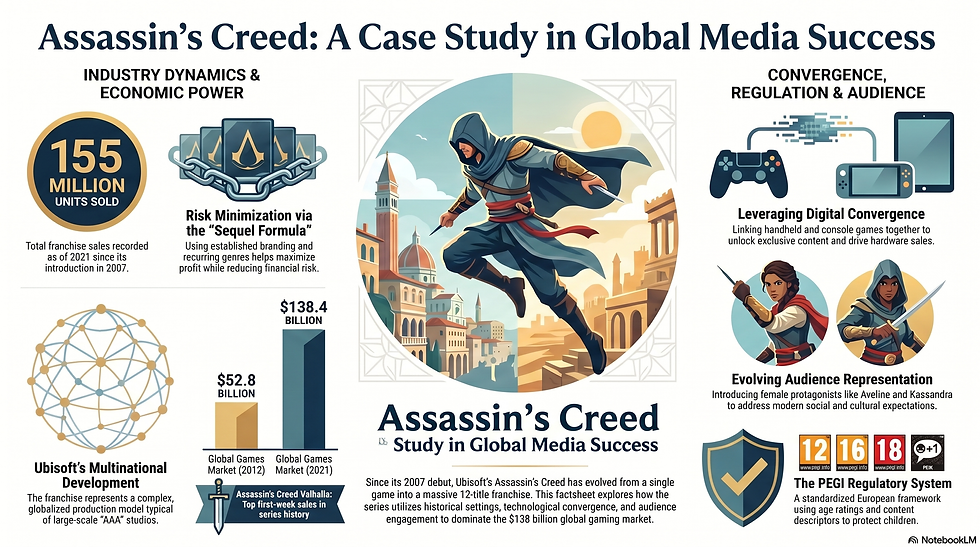
Franchise Growth and Reach: By 2021, how many main incarnations of the game had been released, and what were the total recorded sales units for the franchise since its introduction in 2007?
Technological Convergence: How did the release of Assassin’s Creed III: Liberation on the PS Vita attempt to tap into the burgeoning mobile gaming market, and what features of the hardware facilitated this?
Industry Theory (Hesmondhalgh): According to David Hesmondhalgh, how does the use of "genre-formatting" and the "sequel formula" help a large publisher like Ubisoft minimize financial risk?
Regulation and the VSC: Which organization is currently responsible for regulating video games in the UK, and what is the PEGI system’s primary goal regarding the protection of children across Europe?,
Audience Representation: How has the franchise adapted to changing social expectations regarding female protagonists, and what specific characters are cited as examples of this shift?
Media Effects (Bandura): Why is Albert Bandura’s theory on the imitation of violence considered particularly relevant—or potentially controversial—when applied to the active role adopted by a player in an 18-rated video game?
Participatory Culture (Jenkins): How does Henry Jenkins’ theory of fandom explain the way online communities and "prosumers" (fans who create their own gameplay videos) impact the success and development of a game?,
Future Industry Trends: What is the significance of the shift toward a "fully live service" model for the upcoming Assassin’s Creed Infinity, and how does this strategy aim to ensure the longevity of the franchise?


Comments