

Kiss of the Vampire - Deep Dive

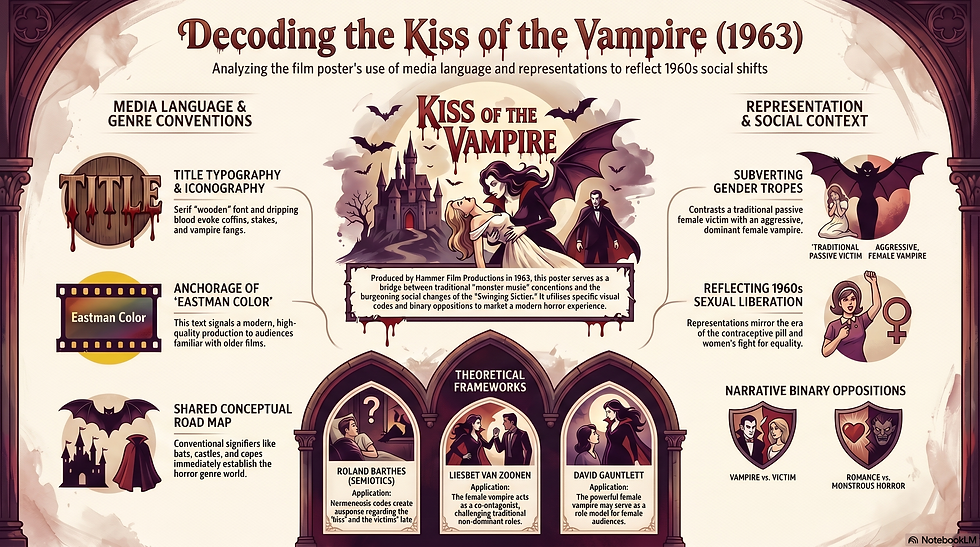
Point Hammer Film Productions utilized specific media language in the Kiss of the Vampire poster to establish its genre identity while signaling a modern update for 1960s audiences. Evidence The poster features a "painted" main image, a capitalised serif font with "wooden" styling, and the explicit anchorage of the text "In Eastman Color". Theory This reflects the 1960s audience’s assumed familiarity with the codes and conventions of "monster movie" posters, such as specific compositions and fonts. Analysis While the hand-painted style and gloomy palette (grey, black, and brown) link to Hammer's successful franchises like Dracula, the mention of "Eastman Color" connotes that this is a "modern telling" of an older story. Cultural Context By 1963, Hammer had built a successful "monster movie" brand with franchises like Frankenstein and The Mummy, allowing them to leverage established audience expectations for the genre.
Point The poster utilizes semiotic codes to create suspense and reinforce the dark, frightening nature of the vampire genre. Evidence Visual signifiers such as bats, a full moon, a castle, and blood dripping from the letter 'V' serve as key genre markers. Theory According to Roland Barthes’ semiotics, the "Hermeneutic Code" creates enigmas around the fate of the victims, while "Semantic Codes" apply to conventional images like the bats. Analysis The dripping blood functions as an iconic sign for a fang, and the title's reference to a "kiss" creates a tension between romance and monstrous horror. Cultural Context These elements form part of a "shared conceptual road map" (Stuart Hall) that allows the audience to immediately identify and decode the "world" of the horror film.
Point Kiss of the Vampire uses binary oppositions to structure its narrative world and subvert traditional horror character roles. Evidence The poster contrasts "vampires" with "victims" and the romantic connotations of a "kiss" with the stereotypical "vampire" monster. Theory Applying Claude Lévi-Strauss’ structuralism, meaning is created through these opposing representations. Analysis By placing a male victim in a submissive, knees-on-the-ground pose while a female vampire attacks, the poster creates an opposition to the typical "damsel in distress" trope. Cultural Context This structural conflict reflects the changing social dynamics of the early 1960s, where traditional power structures were beginning to be questioned.
Point The representation of women in the poster oscillates between "older" passive stereotypes and more modern, aggressive depictions reflecting the start of women’s sexual liberation. Evidence One woman is shown in a stereotypical "passive victim" pose, while another is depicted baring her teeth and raising her arm "fist-like" as she bites a male victim. Theory Liesbet Van Zoonen’s feminist theory suggests the female vampire contributes to social change by stepping into a "co-antagonist" role rather than just a victim. Analysis While the pale, light-material dresses reinforce femininity by highlighting curves, the aggressive gesture codes of the female vampire represent her in a non-stereotypically dominant way. Cultural Context This occurs during the "swinging sixties" and the introduction of the contraceptive pill (1960), a time when feminists were campaigning for equal pay and greater social equality.
Point The poster’s portrayal of a dominant female vampire and a fearful male vampire encodes "male fears" of women challenging established social hierarchies. Evidence The lead male vampire is shown with his arm thrown across his body in a defensive gesture, appearing uncharacteristically fearful. Theory David Gauntlett’s theory of identity suggests that the female vampire could serve as a role model for women struggling against male oppression. Analysis The reversal of power—where the male victim has his throat exposed and the male vampire is in a defensive stance—suggests a world where traditional male control is under threat. Cultural Context This reflects a 1963 context where women were increasingly entering the paid workforce and equal pay legislation was being passed in America.
Point The institutional context of the film's distribution and marketing highlights the competitive nature of the horror genre in the early 1960s. Evidence Produced by Hammer but distributed by J. Arthur Rank and Universal, the film was intended as a sequel to 1958’s Dracula but makes no reference to the character in the script. Theory This reflects the industry's need to distance the product from unfavourable comparisons to earlier versions, such as Christopher Lee's portrayal of Dracula. Analysis By listing the stars in order of fame and prioritizing highly paid male actors like Clifford Evans, the poster utilizes "star power" to ensure a successful "Universal Release". Cultural Context Against a backdrop of rapid change—such as "Beatlemania" and the Soviet Union launching the first woman into space—Hammer sought to maintain its dominance in the "monster movie" market.
Ownership: Who produced the film Kiss of the Vampire, and which major company distributed it?
Media Language: What connotations are created by the serif font used for the title?
Genre Conventions: Name three visual signifiers used on the poster that are conventional to the horror/vampire genre.
Semiotics: According to the sources, how is Barthes' Hermeneutic Code (enigma) applied to the poster?
Social Context: What significant events of 1960 and 1963 relate to the theme of women’s sexual liberation and equality?
Representation: How does the "gesture code" of the woman on the right of the poster challenge traditional gender stereotypes?
Feminist Theory: According to Liesbet Van Zoonen, how does the female vampire differ from the stereotypical female victim?
Structuralism: Identify one binary opposition used to construct the meaning of this film poster.
Glossary of Key Terms for Kiss of the Vampire
Anchorage: The use of text, such as "In Eastman Color," to fix the meaning of an image as "modern."
Binary Opposition: A structuralist technique of contrasting opposites, such as vampire vs. victim.
Codes and Conventions: The familiar "rules" of a genre, like the fonts and composition of monster movie posters.
Eastman Color: A technical signifier used to connote that the film is a modern, high-quality production.
Enigma: A mystery or "hook" used to create suspense about the narrative.
Gesture Code: The way a character’s pose or movement communicates meaning, such as a defensive arm or a submissive exposed throat.
Hammer Film Productions: The studio famous for its successful "monster movie" franchises in the 1950s and 60s.
Hermeneutic Code: A semiotic code (Barthes) that creates mystery and suspense for the audience.
Intertext: A media text that is referenced by or compared to another, such as The Evil of Frankenstein.
Male Gaze: (Applied to context) The traditional representation of women as passive victims for a male audience.
Monster Movie: A film genre focused on creatures like vampires, mummies, or Frankenstein's monster.
Passive Victim: A stereotypical representation of a character (usually female) who is powerless against a monster.
Role Model: A character that an audience member can identify with or aspire to be like.
Semantic Code: A sign that carries a specific cultural meaning, like bats signifying horror.
Serif Font: A font with "wooden" styling used here to connote the vampire's coffin or a wooden stake.
Shared Conceptual Road Map: Stuart Hall’s idea that images (like castles and capes) have meanings that are understood by a whole culture


Comments