

Zoella Exam Structure
- Mastering Media

- Mar 3
- 3 min read
Discuss the influence of social and cultural contexts on the representations on the Zoella website. 15/15 Response
POINT: Media production has undergone a fundamental shift toward democratization because the "domestication of technology" has placed high-quality creative tools into the hands of ordinary citizens.
EVIDENCE: Zoe Sugg exemplifies this by beginning her career as an independent creator using a one-camera setup and handheld phone shots in her bedroom to signify authenticity.
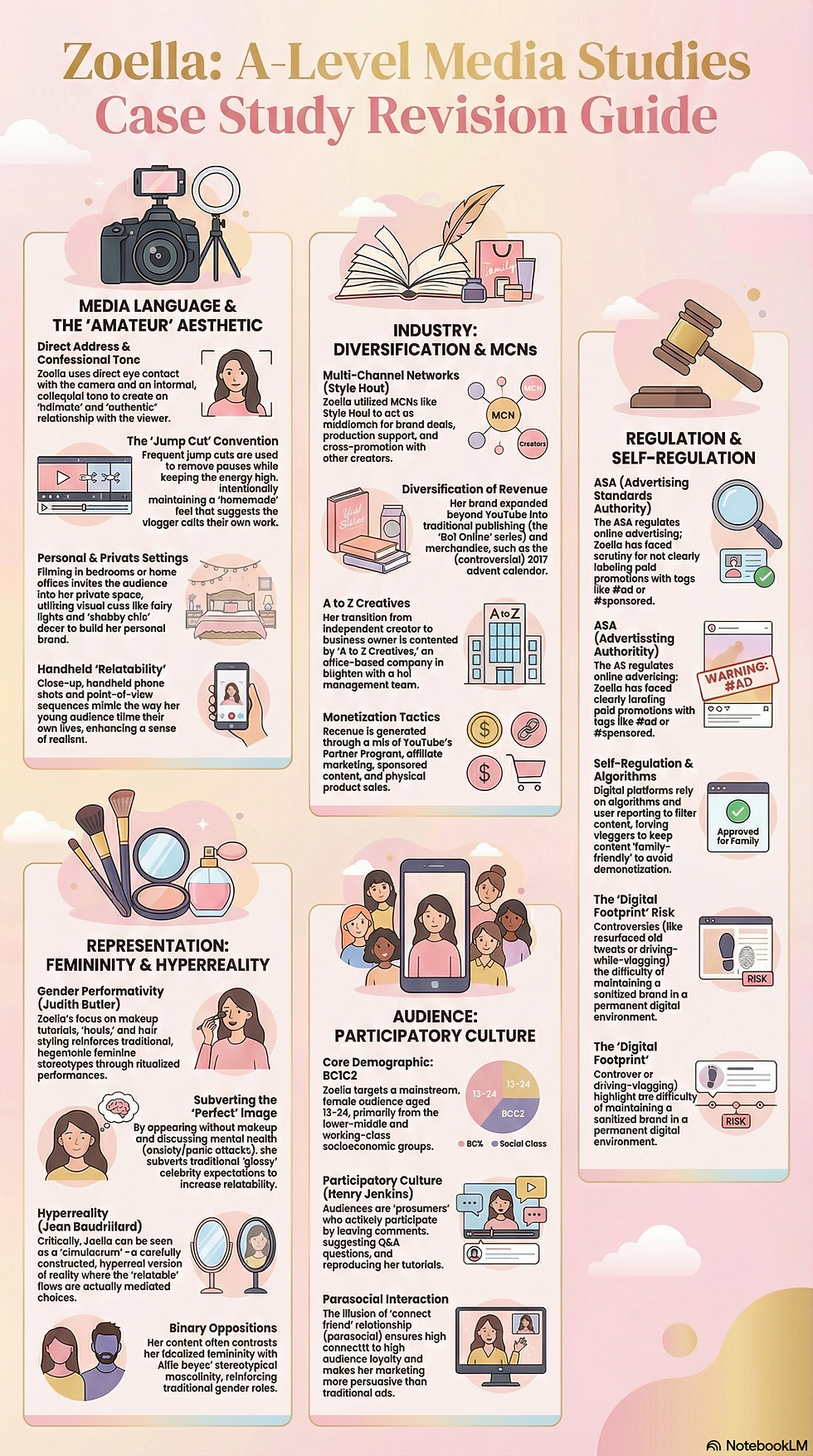
THEORY: This transformation aligns with Clay Shirky’s "End of Audience" theory, which suggests that the internet has allowed passive consumers to become "prosumers" who produce and distribute their own content.
ANALYSIS: By deliberately leaving in mistakes and utilizing jump cuts rather than continuity editing, Sugg constructs a relatable persona that fosters an intimate parasocial relationship with her viewers.
CULTURAL CONTEXT: This represents a move away from traditional "gatekeepers" who previously decided who could become a media star, allowing the "girl next door" to achieve global celebrity status.
POINT: Media distribution has evolved from linear broadcasting to a complex system of digital convergence where content is circulated instantly across multiple online platforms.
EVIDENCE: Sugg utilizes a cross-media brand strategy, distributing content through her YouTube channels ("Zoella" and "MoreZoella"), Instagram, and her dedicated website, Zoella.co.uk.
THEORY: This multi-platform approach reflects Henry Jenkins’ theory of "participatory culture," as audiences are encouraged to interact via comments, likes, and shares, becoming active participants in the content's circulation.
ANALYSIS: Distribution is further optimized through algorithmic features like YouTube’s autoplay and website "Read Next" buttons, which are designed to maximize audience engagement and "time spent" on her sites.
CULTURAL CONTEXT: Consequently, the relationship between producer and audience has been reconfigured, shifting from a one-way broadcast to a socially dimensioned community with a shared history.
POINT: The vlogging industry has transitioned from amateur hobbyism to a highly professionalized and vertically integrated corporate structure.
EVIDENCE: Sugg co-founded A to Z Creatives, a company based in a Brighton office that employs specialized staff, including a social media manager and a creative producer, to manage her brand.
THEORY: This professionalization supports Curran and Seaton’s theory that media industries are driven by "profit and power," leading to the creation of "sanitized" and family-friendly content to protect lucrative sponsorships.
ANALYSIS: To maintain this commercial power, Sugg frequently collaborates with other influencers like Alfie Deyes, using cross-promotion to broaden her target audience reach.
CULTURAL CONTEXT: In the 21st century, this has resulted in the internet's radical potential being partially incorporated into a large, profit-oriented set of cultural industries.
POINT: Media monetization has changed as creators now diversify their brands into traditional industries to minimize financial risk.
EVIDENCE: Sugg has expanded her revenue streams beyond YouTube click-through rates by launching merchandise, beauty ranges, and becoming a record-breaking author with her novel Girl Online.
THEORY: This strategy validates David Hesmondhalgh’s Cultural Industries theory, which argues that producers maximize profit by replicating successful formats and branching out into established markets.
ANALYSIS: Her brand creates a "hyperreal" version of life—a carefully mediated simulacrum—that blends aspirational lifestyle choices with a constructed sense of reality.
CULTURAL CONTEXT: This commercial growth has led to increased regulatory intervention from the Advertising Standards Authority (ASA), which now requires influencers to use hashtags like #ad to clearly disclose paid promotions to their young audience.


Comments