

Duran Duran, Lizzo and Justin Bieber

Updated: Feb 25
The music videos for Duran Duran’s "Rio," Justin Bieber’s "Intentions," and Lizzo’s "Good as Hell" provide a comprehensive look at how media language, representation, and industry trends have evolved from the 1980s to the 2020s.
Duran Duran’s "Rio" (1982) serves as a hallmark of the MTV era, a period where music videos became essential marketing tools for international fame. The video utilizes a luxurious mise en scène—featuring yachts, champagne, and designer suits—to establish a narrative of 1980s decadence and excess. While the camera work initially utilizes the "male gaze" through objectifying close-ups of the female character, Rio, the video complicates this dynamic. Rio is depicted as an empowered figure who subverts traditional gender roles by actively rejecting the band members' advances, such as kicking them into the water.
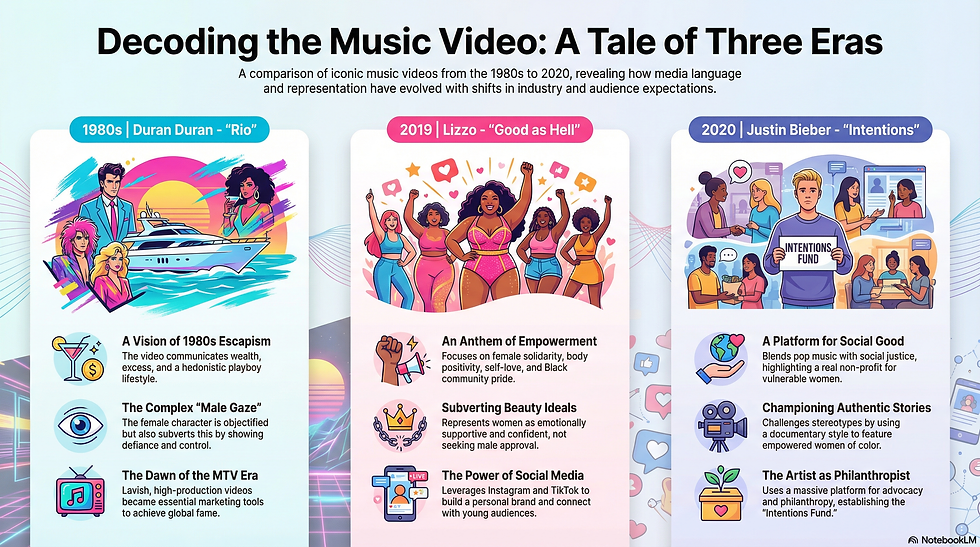
In contrast, Justin Bieber’s "Intentions" (2020) represents a shift toward social justice and philanthropy. Directed by Michael D. Ratner, the video abandons high-budget pop glamour for a documentary-style approach filmed at Alexandria House, a non-profit supporting vulnerable women and children. The video uses wide-angle shots to signify community and voiceovers from residents to provide authenticity and emotional impact. This product challenges stereotypical representations of women of color and illustrates Bieber's mature digital strategy, which integrates music with advocacy and the "Intentions Fund".
Lizzo’s "Good as Hell" (re-released 2019) focuses on Black empowerment and body positivity. Set at Southern University, a Historically Black College and University (HBCU), the video celebrates the traditions of marching bands and "school pride". Its media language follows music video conventions by blending performance with a narrative of three female students overcoming personal conflicts. Lizzo’s presence as a successful Black woman who is proud of her body acts as a role model for audiences, challenging beauty ideals through a post-feminist lens that emphasizes self-love rather than the male gaze. The song's success as a "sleeper hit" highlights the power of cross-platform convergence, where Lizzo utilized TikTok, Instagram, and television appearances to achieve mainstream dominance.
Together, these case studies demonstrate how music videos have transitioned from purely escapist spectacles in the 80s to socially conscious platforms that prioritize inclusivity and active audience engagement in the digital age.


Comments