

The Guardian - Deep Dive

Point The Guardian utilizes a combination of serious news values and lifestyle-focused media language to appeal to its well-educated and affluent readership. Evidence The front page features factual, focused headlines alongside a prominent skyline promoting the G2 supplement, which includes features on office culture and the intersection of art and wine. Theory This reflects structuralism, where the newspaper balances "hard news" with "soft news" supplements to satisfy the diverse expectations of its 86% ABC1 audience. Analysis By integrating lighter lifestyle elements with serious reporting, the paper positions itself as a comprehensive brand for a digitally-savvy audience rather than just a traditional news provider. Cultural Context This design acknowledges the changing consumer needs of its audience, who value high-brow cultural content as a core part of their collective liberal identity.
Point The publication constructs a highly unflattering representation of Boris Johnson to question his authority and capability during the "Partygate" scandal. Evidence A dominant long shot shows the Prime Minister jogging in a beanie hat, woollen jumper, and "clownish" fish-patterned shorts, which is described as an entirely unstatesmanlike image. Theory This aligns with Stuart Hall's theory of representation, where specific signs and images are selected and combined to encode a preferred meaning for a liberal, anti-Johnson audience. Analysis The contrast between the serious role of a Prime Minister and this "unsportsmanlike" appearance mediates Johnson as inept and lacking the composure required for high office. Cultural Context This representation resonates with the political context of the time, mirroring public shock over government leaders breaking the same lockdown rules they enforced on the people.
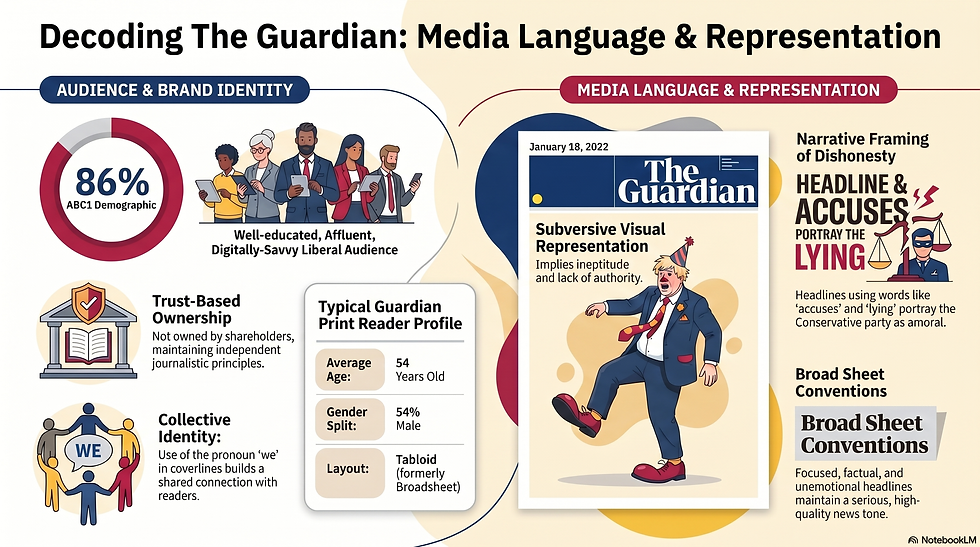
Point The newspaper utilizes factual but emotionally charged headlines to frame the Conservative government as fundamentally dishonest and amoral. Evidence Headlines such as "Cummings accuses PM of lying" and "Inquiry launched into Mone over ‘VIP lane’ deal" use dramatic terms like "accuses" and "lying" to highlight political scandals. Theory According to narrative theory, these headlines function as enigma codes that tease the reader to investigate a political "spat" while establishing a broader narrative of Conservative dishonour. Analysis By focusing on accusations of lying, the paper emphasizes the significance of the ministerial code and the expectation that leaders must abide by the rules they pass in parliament. Cultural Context This framing occurs against the backdrop of the COVID-19 pandemic, where the public was legally prohibited from social mixing while government "parties" reportedly took place.
Point The Guardian creates a strong collective identity with its audience through its choice of inclusive coverlines and language. Evidence The coverline "What we miss about working in the office" employs the collective pronoun "we," while the Ukraine story uses the term "UK" to imply shared national interest. Theory This reflects Gerbner’s cultivation theory, where the repeated use of inclusive address shapes a shared worldview among its predominantly middle-aged and professional readership. Analysis By addressing its readers as office workers, the paper reinforces a sense of community among white-collar professionals who navigated the "work from home" culture of the pandemic. Cultural Context The paper targets a "mainstream left" audience that, while not necessarily affiliated with a specific party, shares deep-rooted liberal and progressive traditions.
Point The newspaper’s unique ownership structure allows it to maintain a degree of journalistic independence and core principles not seen in shareholder-owned papers. Evidence Unlike most other national publications, The Guardian is not owned by a group of shareholders for whom making a profit is the primary imperative. Theory This contrasts with Curran and Seaton's theory on power and media industries, as the paper is not driven by the same corporate conglomerate interests that might limit journalistic freedom. Analysis This economic independence enables the paper to be more overtly critical of power and to maintain its core principles of holding the government to account. Cultural Context In an industry often dominated by right-wing press conglomerates, The Guardian positions itself as a distinct voice that prioritizes responsible journalism over global power.
Point The paper has successfully adapted its traditional broadsheet identity to a modern tabloid format and a globally conscious digital presence. Evidence Originally a broadsheet, the paper moved to a tabloid format for cost reasons and changing consumer needs while reaching over 100,000 daily print readers. Theory This shift reflects the "End of Audience" theory as the paper must provide "inclusive" content that appeals to active, digitally-savvy readers across multiple platforms. Analysis The omission of specific Conservative ministers' names in the Ukraine story suggests the paper expects its audience to support collective national action over government-specific defense policies. Cultural Context By adapting its format and embracing digital-savvy demographics, The Guardian ensures its longevity as a key liberal "news provider of the year" in the UK media landscape.

1. Audience Demographics: According to the source, what is the specific socioeconomic profile of The Guardian’s readership, and what is the average age of a print reader?
2. Ownership and Independence: How does The Guardian's ownership structure differ from most other national newspapers, and what impact does this have on its journalistic principles?
3. Media Language (Visuals): How does the long shot of Boris Johnson jogging—specifically his clothing and appearance—convey a specific message about his authority and capability?
4. Headline Analysis: What dramatic terms are used in the main headline regarding Dominic Cummings, and how do they frame the relationship between the Prime Minister and the ministerial code?
5. Audience Engagement (Identity): How does the coverline "What we miss about working in the office" use inclusive language to create a collective identity for its readers?
6. Product Format: Why did The Guardian transition from a traditional broadsheet format to its current tabloid format?
7. Mediation of Politics: In what way does the paper’s coverage of the "VIP lane" inquiry involving Michelle Mone reinforce the paper's broader representation of the Conservative Party?
8. Contextual Representation: How does the newspaper use inclusive language like "UK" in the Ukraine story whileomitting the names of specific Conservative ministers?
ABC1 Demographic: A socioeconomic classification referring to the middle and upper classes.Example: 86% of The Guardian’s audience belongs to this affluent, well-educated group.
Anchorage: The use of text to "fix" or stabilize the meaning of an image. Example: The caption identifying "Dilyn" the dog and the location "St James’s Park" anchors the image of Boris Johnson jogging.
·Coverline: Brief text on the front cover that highlights features inside the paper or its supplements.Example: The coverline "What we miss about working in the office" targets the paper's core audience of professional workers.
·Inclusivity: The use of language that aims to involve the reader in a shared experience or identity. Example: Using the collective pronoun "we" in lifestyle features or "UK" in international news to imply a shared national interest.
·Long Shot: A camera or photographic framing that shows the subject from a distance, revealing their full body and surroundings. Example: The dominant image of Boris Johnson is a long shot that emphasizes his "clownish" attire, such as his fish-patterned shorts.
·Mainstream Left: A political position that leans toward liberal, progressive values without necessarily being tied to a specific party. Example: The Guardian is described as having mainstream left values, which informs its critical representation of right-wing politicians.
Mediation: The process of selecting and shaping information to represent a particular version of reality. Example: The paper mediates the "Partygate" scandal by focusing on accusations of "lying" to frame the government as amoral.
·Skyline: A horizontal strip across the top of the front page used to promote supplements or specific features. Example: The G2 supplement skyline offers lighter cultural content, such as "art and wine," to balance the hard-hitting political news.
·Supplement: A separate section or magazine included with the main newspaper. Example: G2 is The Guardian’s regular supplement that focuses on lifestyle, office culture, and entertainment.
Tabloid Format: A smaller newspaper size that was traditionally associated with popular press but is now used by broadsheets for cost efficiency.Example: The Guardian changed to a tabloid format due to changing consumer needs and cost reasons.


Comments