

K-pop Demon Hunters
- Mastering Media

- Apr 17
- 4 min read
Updated: Apr 28
Industry
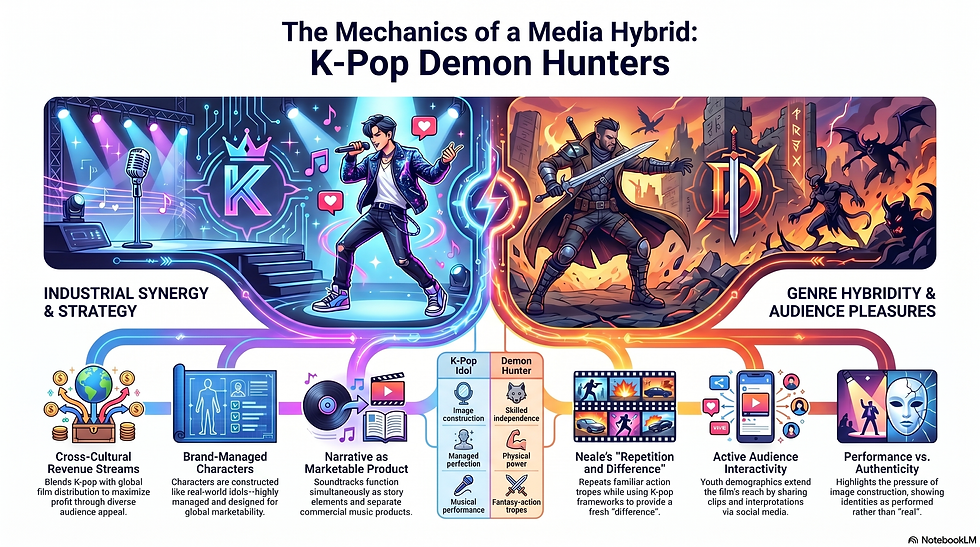
K-pop Demon Hunters reflects the increasing globalisation of media production, blending South Korean pop culture with mainstream international film distribution. The film is designed to appeal to both K-pop fans and wider mass audiences, showing how industries maximise profit through cross-cultural appeal. Its soundtrack is a key industrial strategy, with songs functioning as both narrative elements and marketable products. This synergy between film and music highlights how media industries create multiple revenue streams. The film also demonstrates the importance of branding, with characters constructed in a way similar to real K-pop idols—highly managed and globally marketable.
Audience
The film targets a broad, youth-oriented demographic, particularly fans of K-pop and action genres. It offers pleasures of escapism, spectacle, and identification. Fans of K-pop may enjoy the insider references to idol culture, while others are drawn in by the action narrative. The dual identity of the characters (idols and demon hunters) allows audiences to engage with themes of pressure, performance, and self-identity. Active audiences may also engage through social media, sharing clips, music, and interpretations, demonstrating audience interactivity and extending the film’s reach beyond the cinema.
Representation
The film presents a stylised and empowering representation of young performers, particularly women, as skilled, independent, and powerful. However, it also reflects the pressures of image construction and perfection associated with K-pop culture. Identities are constructed through performance, suggesting that what we see is not always “real.” There is also a blend of cultural representation, combining Korean cultural elements with globalised fantasy tropes, raising questions about cultural hybridity and authenticity.
Media Language (Steve Neale)
Using Steve Neale’s genre theory, the film can be understood as a hybrid genre text, combining action, fantasy, and musical elements. Neale argues that genres rely on repetition and difference—and this is clear here. Familiar genre conventions (fight scenes, heroes vs villains) are repeated, while the K-pop idol framework provides difference, making the film feel fresh. Bright visuals, fast-paced editing, and choreographed combat sequences reflect both music video and action film styles, reinforcing this genre blend.
1. How does the film utilise globalisation and cross-cultural appeal to successfully target a mass audience beyond the traditional K-pop fan base?
2. In what ways do active audiences use social media to create interactivity and extend the film's narrative reach?
3. How does the film manage the tension between providing an empowering representation of independent women and reflecting the rigid image construction associated with K-pop culture?
4. Applying Steve Neale's genre theory, how does the film use repetition and difference to make its hybrid genre blend of action, fantasy, and music feel "fresh" to viewers?
5. How does the dual role of the soundtrack—acting as both a narrative element and a marketable product—demonstrate the industrial strategy of creating multiple revenue streams?
6. To what extent does the film suggest that identity is a performance, and how does this relate to the highly managed branding of real-life K-pop idols?
7. How does the film's use of cultural hybridity (mixing Korean elements with global fantasy tropes) impact the audience's perception of authenticity?
8. How do the genre conventions of choreographed combat and bright visuals reinforce the film’s identity as a hybrid text that appeals to both action fans and music lovers?
K-pop Demon Hunters – Check Your Learning Quiz
1. What does globalisation refer to in this film?A. Filming only in one countryB. Blending different cultures to reach international audiencesC. Using only English language dialogueD. Limiting the film to local cinemas
2. How does the film achieve cross-cultural appeal?A. By focusing only on Korean audiencesB. By removing all cultural referencesC. By combining K-pop with global action/fantasy elementsD. By avoiding music
3. The soundtrack is an example of:A. A failed marketing strategyB. A narrative element onlyC. A marketable product onlyD. Both a narrative element and a marketable product
4. Why is branding important in the film?A. It makes the film shorterB. It helps create recognisable and marketable charactersC. It reduces production costsD. It removes the need for a storyline
5. Which of the following is an example of audience pleasure?A. ConfusionB. EscapismC. BoredomD. Silence
6. What is audience interactivity?A. Watching a film onceB. Ignoring mediaC. Engaging with content through social media and sharingD. Turning off the film early
7. What does representation focus on?A. Camera equipmentB. How people and ideas are portrayedC. Ticket pricesD. Film length
8. What is cultural hybridity?A. Keeping cultures completely separateB. Mixing elements from different culturesC. Removing all cultural identityD. Only using Western ideas
9. According to Steve Neale, genres rely on:A. Random ideasB. Repetition and differenceC. No structureD. One fixed formula
10. Why is K-pop Demon Hunters a hybrid genre film?A. It only uses one genreB. It avoids genre conventionsC. It combines action, fantasy, and musicD. It has no clear style
Glossary
1. GlobalisationThe process by which media products are created and distributed across international markets, blending cultural influences to reach global audiences.
2. Cross-cultural appealThe ability of a media product to attract audiences from different cultures by combining familiar and diverse elements.
3. Mass audienceA large, broad audience that media producers target to maximise popularity and profit.
4. BrandingThe creation of a recognisable identity (e.g. characters, style, image) that can be marketed and sold to audiences.
5. Narrative elementA part of the story (e.g. music, characters, events) that helps develop the plot or meaning.
6. Marketable productA media element designed to be sold separately (e.g. soundtrack, merchandise) to generate additional revenue.
7. Audience interactivityThe way audiences actively engage with media, often through social media, sharing, or creating content.
8. RepresentationHow people, groups, or ideas are portrayed in media texts.
9. Cultural hybridityThe mixing of elements from different cultures to create something new.
10. Genre conventionsTypical features or elements commonly found in a particular genre (e.g. action scenes in action films).
Answer Key
B
C
D
B
B
C
B
B
B
C


Comments