

Predictions for GCSE Component 1

An analysis of the Component One "Exploring the Media" exam papers from 2019 to 2025 reveals a highly structured format that consistently tests four key areas of the theoretical framework: Media Language, Representation, Media Industries, and Audiences.
1. Frequency of Topics Assessed
The exam is divided into two sections, with topics rotating between set products each year.
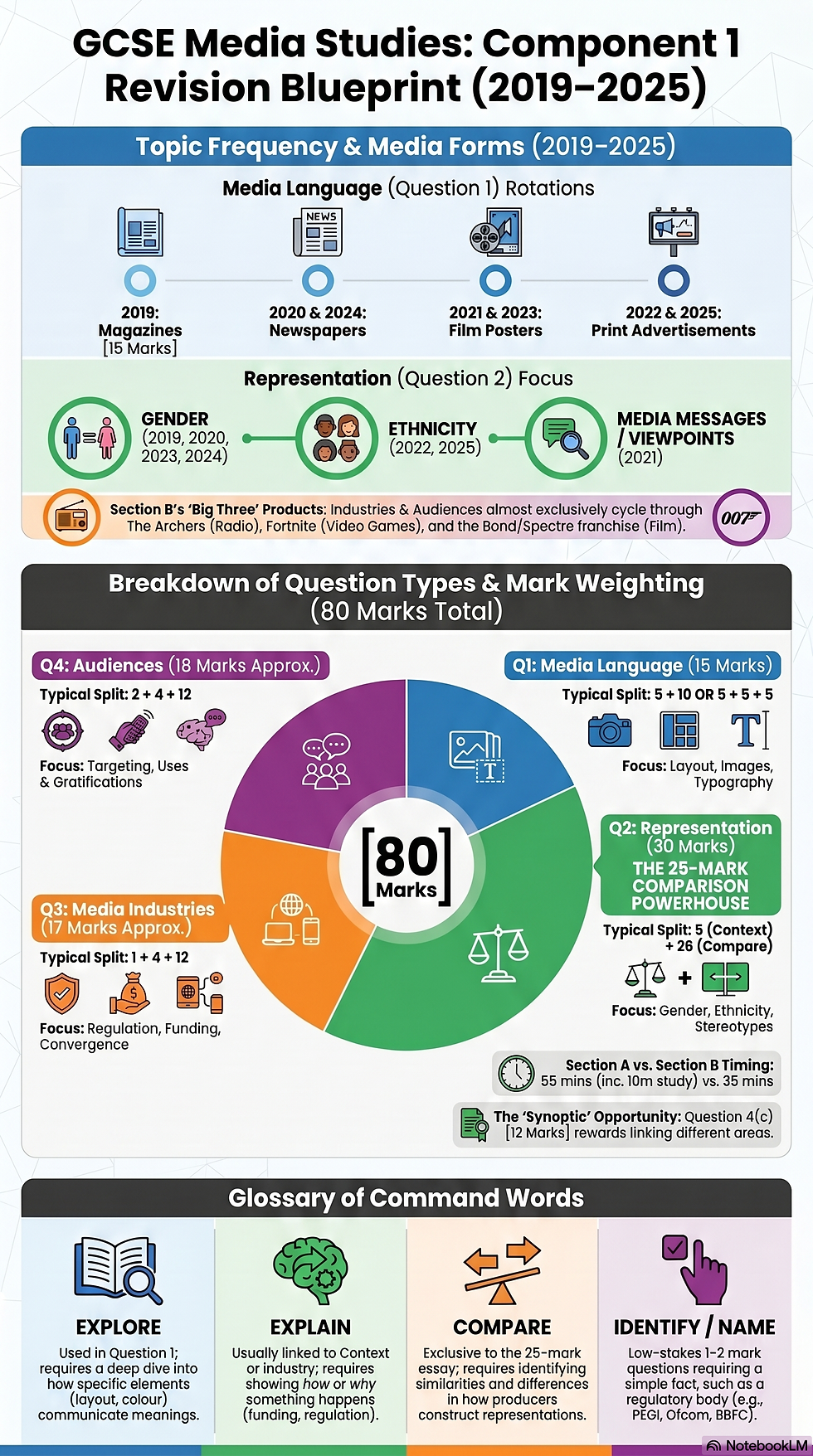
Section A: Media Language (Question 1): This 15-mark question rotates across print-based media.
Newspapers: Assessed in 2020 (The Guardian) and 2024 (The Guardian).
Magazines: Assessed in 2019 (GQ).
Film Posters/Marketing: Assessed in 2021 (The Man with the Golden Gun) and 2023 (Spectre).
Print Advertising: Assessed in 2022 (This Girl Can) and 2025 (Quality Street).
Section A: Representation (Question 2): This 30-mark section (split into 5 and 25 marks) consistently focuses on how specific groups or ideas are portrayed.
Gender: A frequent focus, appearing in 2019 (Print Ads), 2020 (Men in Film Posters), 2023 (Men in Magazines), and 2024 (Film Posters).
Ethnicity: Assessed in 2022 (Magazines) and 2025 (Magazines).
Viewpoints/Messages: Assessed in 2021 (Newspapers).
Section B: Media Industries and Audiences (Questions 3 & 4): These sections alternate between Radio, Video Games, Film, and Newspapers.
Radio (The Archers): Featured heavily in 2019 (Industries), 2020 (Audiences), 2021 (Audiences), 2023 (Industries), and 2024 (Industries).
Video Games (Fortnite): Appears almost every year, alternating between Industry focus (2020, 2021) and Audience focus (2022, 2024, 2025).
Film (Spectre/007): Assessed in 2022 (Industries) and 2025 (Industries).
Newspapers (The Sun): Assessed in 2019 (Audiences) and 2023 (Audiences).
2. Type of Questions
The papers follow a predictable marking and structural pattern:
Short Answer (1–2 marks): Found in Section B, requiring candidates to "Name" an organization or "Identify" an audience.
Brief Explanation (4–6 marks): These ask for specific knowledge, such as explaining "funding" or "marketing" strategies.
Structured Analysis (5 marks): Question 1(a) and 2(a) consistently use 5-mark slots to test specific media language elements or the influence of contexts (Social, Cultural, Historical, or Political).
Extended Response (10–12 marks): These require more depth, often appearing in Section B to explain industry practices or audience theories like Uses and Gratifications.
Comparison (25 marks): This is the largest single question (2b), requiring an extended, structured comparison of two products—one "set" product and one "unseen" resource.
Synoptic Question: Usually Question 4(c) (or 3c in some years), this explicitly rewards students for drawing together knowledge from across the full course of study.
3. Command Words
The exams use specific command words to signal the required depth of the answer:
"Explore": Used for Media Language (Q1), asking candidates to analyze how meanings are communicated through codes like images, layout, and typography.
"Explain": Used for questions on context, industries, and audiences. It requires a demonstration of how or why something happens (e.g., "Explain how contexts influence newspapers").
"Compare": Specifically for Question 2(b), requiring candidates to identify similarities and differences in representation between two products.
"Name / Identify / What type": Used for low-tariff questions requiring simple, factual recall.
"Briefly explain": Found in Section B for 4–5 mark questions, requiring a concise response that still provides a clear reason or method.
Section A: Media Language and Representation Predictions
Question 1: Media Language (15 Marks)
Product Prediction: Magazines (GQ) or Print Advertising (This Girl Can).
Reasoning: The 15-mark Media Language question rotates through the print-based set products. Magazines haven't appeared in this slot since 2019. While film posters and newspapers appeared recently (2023 and 2024 respectively), and Quality Street was the focus in 2025, Magazines are the most "overdue" for a dedicated media language analysis.
Likely Focus: Expect tasks asking you to "Explore" typography, visual codes (lighting, setting, dress), or layout and design.
Question 2: Representation (30 Marks total)
Product Prediction: Newspapers (The Sun and Daily Mirror).
Reasoning: The 25-mark comparison question (2b) focused on Magazines in 2025 (Ethnicity) and Film Posters in 2024 (Gender). Newspapers have not been the focus of the comparison question since 2021, making them a very strong candidate for this year.
Focus Prediction: If newspapers are selected, the focus will likely be on political or social viewpoints and how they represent specific events or groups.
Context (2a): You will likely be asked to explain how social or historical contexts influence these representations.
Section B: Media Industries and Audiences Predictions
Question 3: Media Industries
Product Prediction: Radio (The Archers).
Reasoning: The Archers was entirely absent from the 2025 paper. Historically, it appears in Section B almost every other year.
Likely Questions:
Regulation: Naming Ofcom and explaining its role in radio.
Funding: Explaining the difference between public service broadcasting (BBC) and commercial funding.
Technology/Distribution: How the BBC uses digital platforms (like BBC Sounds) to reach audiences.
Question 4: Audiences
Product Prediction: Newspapers (The Sun) or Video Games (Fortnite).
Reasoning: The Sun hasn't appeared in Section B for the last two years. If it appears, expect questions on audience categorization or how digital platforms attract readers. If Fortnite appears, it often focuses on marketing or interactive features.
The Synoptic Question (4c): This 12-mark question consistently asks you to "draw together knowledge". It is highly likely to require the application of Uses and Gratifications theory to explain audience engagement with either a newspaper website or a video game.
Summary of Key "Due" Topics
Theory: Uses and Gratifications is the most frequently assessed theory for the synoptic question and is a safe bet for 2026.
Industry Concept: Regulation or Media Conglomerates are high-frequency topics that often appear as short-answer or mid-length explanations.
Command Words: Prepare specifically for "Compare" in Q2(b) and "Explain how" in Section B, as these carry the highest mark weightings


Comments