

Banksy and Advertising

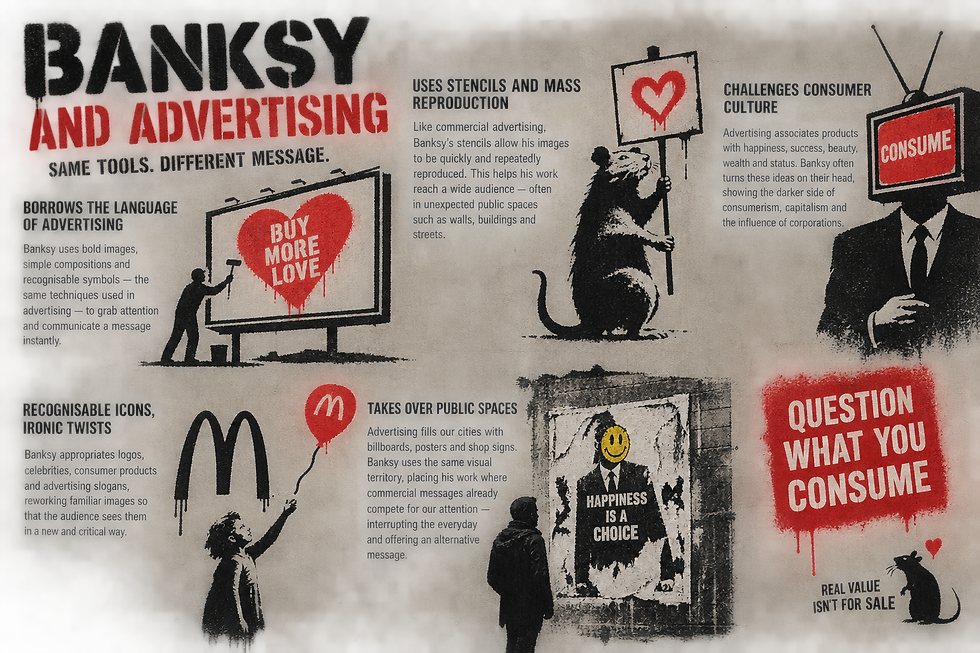
Banksy is heavily influenced by the visual language and techniques of advertising. His work often uses bold images, simple compositions, recognisable symbols and short, memorable messages that can be understood quickly. Like an advertisement, a Banksy artwork is designed to grab the audience’s attention and communicate an idea almost instantly. However, instead of using these techniques to persuade people to buy something, Banksy frequently uses them to question the values and messages promoted by advertising.
Banksy’s use of stencils is particularly effective because they allow images to be reproduced quickly and consistently. This connects with the mass-production techniques used by commercial advertising, where the same logo, slogan or image is repeatedly displayed to reach a large audience. Banksy takes this idea into public spaces, placing his work on walls and buildings where it can unexpectedly interrupt the commercial and visual environment of the city.
Advertising often associates products with ideas such as happiness, success, beauty, wealth and status. Banksy frequently challenges these associations by placing familiar commercial imagery into unexpected or ironic situations. His work can therefore expose the difference between the idealised world presented by advertising and the realities of everyday life.
Banksy also appropriates logos, celebrities, consumer products and advertising-style slogans, transforming familiar images so that audiences look at them differently. This creates irony: an image that might normally encourage consumption is instead used to make the viewer question consumption.
His work is particularly effective because it appears in the same public spaces where advertising operates. Billboards, shop signs and posters compete for our attention, and Banksy effectively uses the same visual territory to present an alternative message.
In this sense, Banksy does not simply reject advertising. He borrows its visual language and turns it against itself, using the techniques of commercial persuasion to encourage audiences to think critically about consumerism, capitalism and the influence of corporations on modern society.
How is Banksy influenced by the visual language of advertising?
Why are Banksy’s stencils particularly effective for communicating his ideas?
How does Banksy use public spaces to challenge commercial advertising?
What values does advertising often associate with products? Give at least three examples from the text.
How does Banksy create irony by using logos, celebrities, consumer products and advertising-style slogans?
What is the difference between the purpose of Banksy’s work and the purpose of commercial advertising?
How does Banksy challenge ideas about consumerism and capitalism through his artwork?
Explain the statement: “Banksy borrows advertising’s visual language and turns it against itself.” Use examples from the text in your answer.


Comments